
Burnout Isn't "Just Stress"
Why I Believe We Need to See It Through a Trauma-Informed Lens

Welcome back to Leading the Way, the See the Wonder, LLC’s substack where Tiffany Leader (me, today!), often write and share ponderings, thoughts, and stories in hopes that you will be encouraged, inspired, and supported. Glad & Grateful you are here.
Today I’ve been pondering a lot on how burnout creates trauma responses and it inspired me to write this article about seeing burn out from a trauma informed lens.

When you hear the word burnout, what comes to mind?
Someone completely up in flames?
Someone who’s simply tired?
Maybe someone who just needs a vacation.
Or perhaps you’ve quietly accepted burnout as part of life.
“It’s just what happens in this profession.”
“Everyone’s burned out.”
“This is just adulthood.”
I used to believe those things too.
But over the last several years, I’ve started asking a different question.
What if burnout isn’t something we’re supposed to normalize?
What if we’ve misunderstood what chronic stress actually does to our brains and bodies?
What if one of the reasons recovery takes so long is because burnout isn’t “just stress”?
The Slide That Always Gets Quiet
Whenever I teach burnout and compassion fatigue trainings, there’s one slide that always changes the room.
I tell participants:
“Burnout and compassion fatigue sit somewhere between acute trauma and the accumulation of chronic, everyday stress. They affect the brain and body in ways that overlap with trauma, especially when stress goes unresolved for long periods of time.”
You can almost see people pause.
Because suddenly their experience makes sense.
Not because they’re weak.
Not because they aren’t resilient enough.
But because chronic stress changes us.
A Quote That Stopped Me
I recently came across this quote from neuroscientist and psychologist Dr. Caroline Leaf.
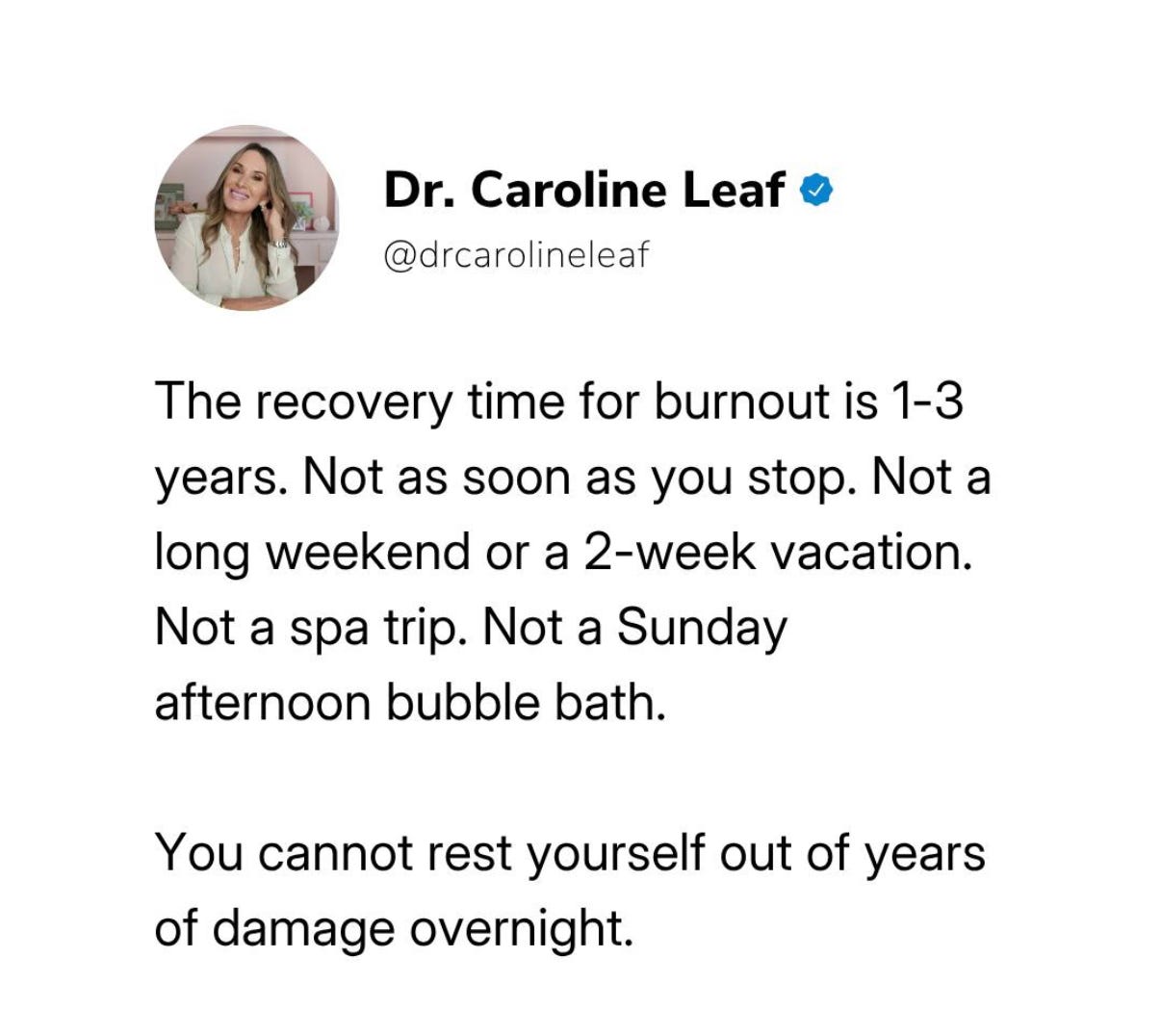
It stopped me.
Because it reminded me that healing from years of chronic stress isn’t simply about “thinking positively” or finding better coping skills (However, sometimes that’s how you start)
It’s about helping the brain and body learn safety again.
If you’ve experienced years of chronic activation...
years of pushing through...
years of overriding your body’s cues...
your nervous system begins adapting to survival.
And when enough stressful experiences stack on top of each other, they begin creating patterns that are incredibly difficult to interrupt.
That doesn’t mean you’re broken.
It means your brain learned to survive.
My Story Didn’t Start With Burnout
This is one of the biggest things I’ve realized.
My story didn’t begin with panic attacks.
It didn’t begin with anxiety.
It didn’t even begin with burnout.
It began years earlier.
As I started healing, I realized I wasn’t uncovering one problem.
I was uncovering layers.
Layers of beliefs.
Layers of expectations.
Layers of patterns that quietly kept me living in chronic stress.
I normalized Burnout

I can remember so many nights early in my social work career when I didn’t leave work until 7:00 or 8:00 p.m.
At the time, it made perfect sense.
“I can stay because I’m single.”
“I don’t mind helping my coworkers.”
“My clients need me.”
So I stayed.
I went above and beyond because it genuinely felt good to help. It felt meaningful. I believed I was making a difference, and honestly, I was. That’s one of the beautiful things about this profession.
But what I didn’t realize was that my body was trying to tell me a different story.
The next morning, I’d be back at work by 7:30 or 8:00 a.m., exhausted before the day had even begun. I’d pour another cup of coffee, tell myself I was just tired, and push through.
I never stopped to wonder what those long days were costing me.
Instead, I justified them.
This is what good social workers do.
This is what being committed looks like.
This season won’t last forever.
I didn’t realize those small, seemingly reasonable choices were slowly teaching my nervous system that my needs always came second.
Looking back now, I don’t think those late nights caused my burnout on their own.
But they were one of many tiny decisions that slowly led me there.
When I look back, I don’t think my perfectionism started in adulthood.
I think it started much earlier.
Growing up, I was often known as the “good” kid.
I also have an older sister who loved pushing boundaries. She questioned things. She was adventurous, creative, and wasn’t afraid to do life differently. Looking back now, I can see those same qualities have helped make her an incredible entrepreneur, visionary, and leader today.
But as kids?
Those qualities often got her into trouble.
Without anyone intentionally teaching me, my little nervous system started paying attention.
I learned what happened when you followed the rules.
I learned what happened when you didn’t.
So I became the easy child.
The dependable one.
The one who tried not to create more stress for the people around me.
I joke now that I simply learned from my sister’s mistakes.
But if I’m honest...
I think what I really learned was how to make myself smaller.
How to stay quiet.
How to avoid disappointing people.
How to earn praise by doing everything “right.”
And somewhere along the way, that slowly became perfectionism.
Not because I wanted to be perfect.
But because perfection felt safe.
Looking back now, I don’t think I was trying to become the perfect child.
I was simply trying to become the child who didn’t add more weight to the room.

Burnout Happens in the Slow Fade
Here’s what I wish more people understood.
Burnout rarely happens overnight.
It happens in the slow fade of losing yourself while serving everyone else.
Please don’t misunderstand me.
Serving others is beautiful.
I still believe that.
Helping people is one of the greatest joys of my life.
But somewhere along the way, service can quietly become self-abandonment.
The lines blur.
You stop noticing where other people end and you begin.
You stop asking yourself what you need.
That’s where burnout begins.
I can remember loving both my work as a social worker and serving in my church. There was a season where it combined as well.
Both filled me with purpose.
Both felt deeply aligned with who I was.
Until they didn’t.
I started dreading showing up.
I resented arriving early.
I resented staying late.
Small requests suddenly felt enormous.
My body had been whispering for years.
Headaches.
Stomach aches.
Brain fog.
Fatigue.
Eventually...
It started shouting.
Anxiety.
Panic attacks.
A body that could no longer pretend everything was okay… even when I justified that “I am fine.”
The Question That Changed Everything
I kept thinking:
“I just need to figure out how to manage this anxiety.”
(I laugh a little now because that wasn’t actually the problem.)
One day my therapist gently challenged me… She said , “Tiffany, when’s it going to get better?” It was a light bulb moment for me.
Instead of helping me manage the anxiety...
she helped me become curious about it.
What if the anxiety wasn’t the problem?
What if it was the messenger? and what was it telling me?
It was telling me that I was burnt out.
That changed everything.
Because suddenly I wasn’t trying to silence my body anymore.
I was finally listening. (after several sessions of her helping me see my body is the messenger and there are some hard decisions I’ve got to make in the near future to help myself).
Healing Isn’t Linear
It took years for me to reach my breaking point.
It makes sense that healing wouldn’t happen in a weekend retreat or after reading one really good book.
Healing has taken years.
I’m still healing.
Not because recovery isn’t possible.
But because healing isn’t about becoming someone new.
It’s about gently returning to the person you were before survival became your default.
I don’t think burnout recovery means you’ll never overextend yourself again.
I think it means you’ll recognize the signs sooner.
You’ll recover faster.
You’ll honor your body earlier.
You’ll choose differently.
Again and again.
A Gentle Reflection
If you’ve been told burnout is “just part of the job,” I hope you’ll question that story.
Because while burnout may be common...
I don’t believe it was ever meant to become normal.
Your body isn’t betraying you.
It’s communicating with you.
And maybe today...
instead of asking,
“How do I push through?”
you could begin asking,
“What has my body been trying to tell me all along?”
Closing Invitation
This is why See the Wonder exists.
Not simply to help people manage burnout.
But to help helpers, caregivers, leaders, and high-achieving humans understand the deeper patterns that keep them stuck in survival—and gently find their way back to themselves.
If this story resonated, I’d love to invite you to subscribe to Leading the Way. Each week, we explore burnout recovery, nervous system regulation, compassion fatigue, and what it looks like to build a life where service no longer requires self-abandonment.
Until Next Time :)
Tiffany